
Dissociation by Design: What Is Your Studio Teaching Your Clients?
In a recent Substack post for the Center for Barefoot Massage, Dissociation On Purpose by Jeni Spring explores using intentional dissociation as a tool for focus and learning rather than as a way to check out. It got me thinking about how this shows up not just in our work habits and nervous system responses, but also in our studios.
I’ve long noticed a trend in the massage world, especially on social media, where treatment rooms are made to feel dark and moody, almost like caves. There are blackout curtains, very low lighting, candles everywhere, twinkle lights on the walls, and windows that are completely covered.
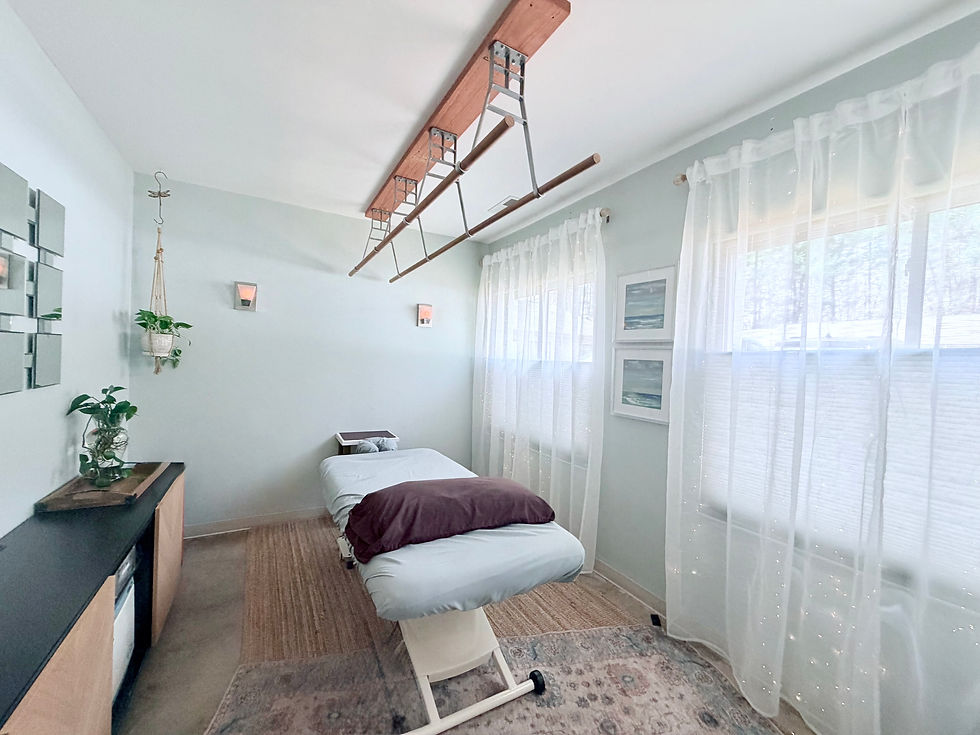
Don’t get me wrong...I love candles and twinkle lights. ;) I have a whole curtain wall of them in my treatment and training room, and they look great at night. But during the day, I keep the shades up. Natural light comes in, the twinkle lights stay on, and the space is still relaxing.
A relaxing space doesn’t have to be dark.
It might look comfy in photos, but honestly, a lot of the time, it just feels too dark and strains my eyes as I get older.
I get the intention to create a calm, relaxing atmosphere. But it makes me wonder: Are we unintentionally designing our rooms to encourage clients to disconnect?
There’s intentional dissociation, like Jeni described, where you step away from distractions and focus. Then there’s the unintentional kind, where attention drifts, and clients lose touch with their bodies.
As therapists, we often talk about presence. But what if our treatment rooms are quietly encouraging clients to escape instead of helping them stay aware in their bodies?
There’s a difference between creating a calm space and encouraging someone to completely tune out. In practices that treat chronic pain or focus on rehab, we need clients to be present in their bodies, not drifting off to sleep.
My Studio Evolution
My first office was one of those classic 'cozy' massage rooms: dark, small, and windowless. It was the kind of space where people would get on the table and immediately check out.
It was a rental, so I didn’t have a choice about the layout or lighting. Even then, I could tell it didn’t fully support the kind of work I wanted to do.
When I started Rolfing school, everything changed. I needed space for clients to walk, room to assess posture and gait, and enough light to observe what was happening with their bodies.
I found another studio with two full walls of windows, and it was glorious. Bright. Open. Alive.
If someone wanted it darker, I offered them an eye pillow. Most of the time, though, they stayed engaged.
They felt relaxed but energized; not relaxed and ready to go home and sleep, but relaxed and aware.
Here’s what mattered most: when clients stayed engaged, we were more successful in addressing their issues.
They noticed real improvement.
They could describe what felt different during the session, track changes, and feel shifts happening in real time. That feedback loop let me adjust my work right away and get better results.
Awareness became part of the treatment.
That space also became my first classroom for barefoot massage instruction. The natural light created clarity. It encouraged participation. It supported focus.
From that point on, I decided I would never work in a space without a window or natural light again.
When I bought my current office, I intentionally designed it. Every treatment room has a window; some have two. We installed top-down blinds for privacy, but they still allow natural light to come through. Therapists can look outside while they work. The rooms feel open instead of enclosed.
That wasn’t just an aesthetic decision. It was a strategic one.
What Is Your Space Encouraging?

Here’s something I want you to consider as a bodywork therapist.
What is your space silently encouraging?
Does your lighting, your space layout, and even your décor invite clients to wake up to their bodies, or to check out completely?
Relaxation matters. Safety matters. But when we are working with chronic pain, postural patterns, movement restrictions, or long-standing dysfunction, awareness needs to be a part of the intervention.
Interoception, the ability to sense what is happening inside the body, is how clients begin participating in their own care. It is how they recognize progress, rather than waiting for something to be done TO them.
If your environment immediately pushes them into sleep mode, you may be limiting that opportunity.
I am not suggesting harsh overhead lighting or a sterile clinic vibe. I am suggesting intentionality.

Light a candle. Keep the room warm and welcoming. Then open the blinds a little. Let in some natural light. Create a space where someone can relax without disappearing.
If you want practical ideas on how to balance comfort and function in your treatment room, I wrote another post, Creating a Relaxing and Functional Space: Decorating Tips for Massage Therapists that dives into layout, décor, and design considerations in more detail.
A Small Challenge for You
This week, stand in your treatment room as if you were seeing it for the first time.
Notice your lighting.
Study your layout.
Examine your decorations.
What message is your space sending before you ever touch their body?
Is it saying, “Chill out, or take a nap”?
Or is it creating space for embodied presence?
The environment you create is part of your treatment plan. Make sure it aligns with the kind of results you want to help your clients achieve.
Sometimes the shift is not in your technique.
Sometimes it’s in the light coming through the window.

